 Find Romantasy Books
The Jasad Heir (The Scorched Throne Book 1)
Sara Hashem
4.4
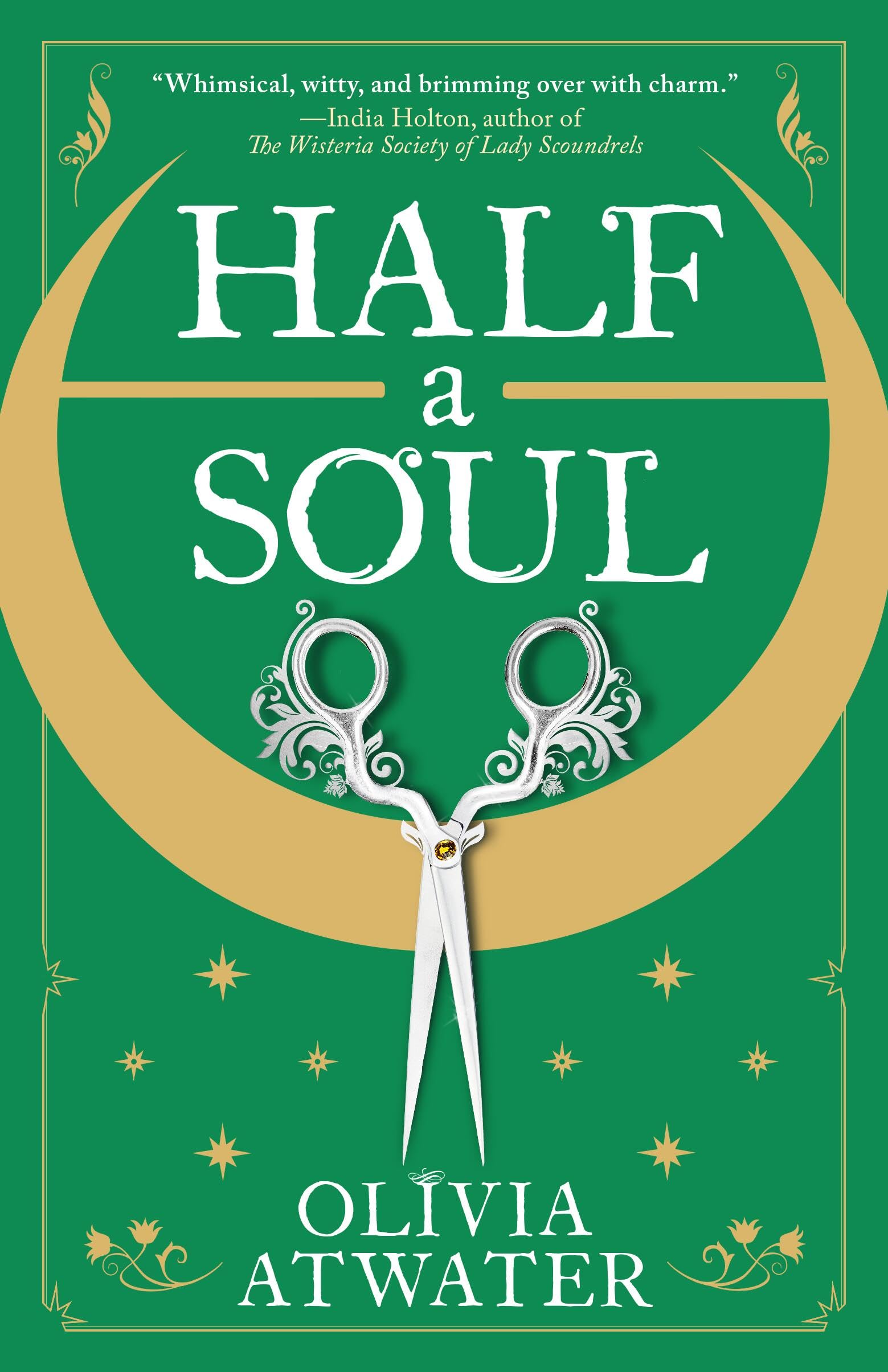
by Olivia Atwater
Theodora Ettings is a young lady with a rather inconvenient problem: thanks to a childhood encounter with a malevolent faerie, she possesses only half a soul. Devoid of fear and embarrassment, Dora finds navigating the rigid expectations of Regency society nearly impossible. While she hopes to remain an inconspicuous wallflower during her London Season, her lack of social caution makes her a magnet for scandal.
Her plans for a quiet life unravel when she encounters Elias Wilder, the formidable and notoriously ill-mannered Lord Sorcier. Tasked with protecting England from magical threats, Elias is the only person who recognizes the nature of Dora’s affliction. Their meeting thrusts Dora into a dangerous world of faerie politics, forcing her to work alongside a man who is as abrasive as he is intriguing.
As they navigate shadowy enchantments and high-society pressures, the forced proximity between the blunt, soul-missing lady and the brooding sorcerer sparks an unexpected connection. Dora must determine if a heart missing its emotional anchor is still capable of finding love, all while risking everything to reclaim her humanity. This whimsical tale balances the wit of a ballroom drama with the perilous allure of faerie bargains.
StephanieFinally, a book for me!
"I've always loved fairies, even as a child and somehow entering my 30s was somehow a 'wake up call' to continue enjoying them! In my focused determination to make sure I was reading at least 3 fairytale/fae inspired books, Half a Soul was eventually captured and thoroughly read on my Kindle. I was pleased but then, noticing Dora.. I began to figure out something! Was she neurodivergent? As I continued to read through her interactions, it became more apparent that this could be the case and ever since I made that revelation - the book was even more enjoyable! She spoke just as I would, saw situations as I do and was still presented as a real character with dignity. Some people think that because she had "half a soul" that she couldn't have any familiarity with emotions like sympathy and anger and found it weird when she acted upon them, which is silly, because you can still recognize them and act upon them after considering it. Lord Elias Wilder? Literally Howl if he was more bitter and world-weary; if he had never met Sophie and continued to force himself to transform, run and eventually fight in a war he didn't believe in. I really did love him from beginning to end and how, deep down, he really is a kind person but was dealt with a rather vicious, unkind hand. The way he shifts around Dora when finding out more about her felt natural and endearing without having to pull out the "you're not like other girls" scenario because after awhile, he also learns to appreciate and be kind to other people! There's a moment in the books where his attitude is addressed and it felt very warm and sweet because it involved more than just Dora but everyone he's ever interacted with. The storyline was very exciting too; I loved how there was drama in the "mortal" realm and eventually the fairy one as well and how it all tied in together. It felt a little like Enola Holmes (second movie) themes as far as factory workers abusing the employees and related to the issues back then without losing the mystical flair this author has worked hard to express. Now, here's for the ending and if you haven't read it or don't want spoilers - read no further! At the end, when it's described that Dora and Elias had lived a long and beautiful life together - it's stated that they travelled to meet their friends one last time, as if in farewell, and disappeared without a trace. This is when Dora finally "fuses" with her other half (the one that holds her emotions, who has then become a fairy and decided to stay behind) and rules as Queen. As someone whose read about elves, the fae and other mystical creatures from several authors - this didn't feel like a method to "cure" Dora at all because in my mind, if Dora had wanted to then she and Elias would have done this a very long time ago but the truth is - Dora's mind hadn't changed. There was nothing wrong with her and Elias agreed. Given how this was presented in the book, it seems like she had "passed on" but on her own merits rather than without warning. Thankfully as I discovered the author's Instagram, it's confirmed that yes - Dora fusing with the other half of her soul was meant to signify that she had passed away! To me, it read a little about how the Elves go to "heaven" in LOTR so I'm relieved that she explained this to others who may feel differently about the ending. I've a lot to thank for this book! After reading this, I got tested and my suspicions were true: I've ADHD and considered neurodivergent. Since then, my life has been more manageable and I feel less embarrassment knowing there's a support system for me that is aware now and that I've a book featuring a wonderful main character who is just like me. <3 ["
April 13, 2024 Verified Purchase
E. GrantThis Book Would Be Perfect, If It Weren't For The Very Last Sentence
"First of all, this is an exceptionally good book which, up until the very last moment, I enjoyed immensely. I was so enthralled I devoured it in a single sitting. I'm not typically a regency or historical fan, but it turns out if you sprinkle a little magic in there I'm completely hooked. And Ms. Atwater handles both the magical fairy tale elements and the very human relationships with rare skill. It is impossible not to love every character introduced, especially Dora herself. I want to make it very clear how compelling and well written this story is, because that is a large part of why it has disappointed me so severely. It it were a less well written book, if it had not gotten my hopes up so very high, it could not have hurt me so much. I am autistic. Like Dora, I struggle to show emotion. My reactions to most things are heavily subdued, and when I do have an emotional reaction, it is often not the one society deems appropriate. I am confused by much of social convention and the behavior of other people which is motivated by feelings I just don't have. My mind wanders easily, I'm rarely focused on what most people would consider important. I often feel incomplete, like a hollow facsimile of a person. I sometimes fear I am incapable of love. I know these are irrational feelings, planted and fostered by the ableist sentiments of the world and people around me. But I feel it anyway. So you can understand why I identified so strongly and immediately with Dora, who's experiences were so incredibly near to my own. So much so that I could only assume this was intentional, that she was meant to be read as a neurodivergent person. Scenes discussing another character's physical disability and drawing what seemed to be direct parallels between he and Dora only reinforced this. The more certain I became that Dora was functionally magically autistic, the more grimly sure I became that in the end, one way or another, she would be "cured." Every disabled person has seen this play out many times. It gets to a point where you're trained to expect it as a rule. If there is a disabled character, especially a main character, in a story that is not specifically about how they are disabled, they will be miraculously healed (or dead) before the story ends. I was already too invested in the story to stop reading so I kept going, trying to prepare myself for the inevitable disappointment. But with every chapter, the story seemed to be setting up to prove me wrong. The exploration of how deeply Dora could feel things, even when she didn't show it, the ways in which her condition put her at a direct advantage over and over, Elias's clear and growing affection for her not in spite of but because of who she was, curse and all-- The higher my hopes rose, the more certain I was that they would inevitably be shattered. And then, like a miracle, the climax of the book came and went and Dora had NOT been cured! Elias declares his love for her exactly the way she is, and she gets her happy ending without shedding this defining piece of her identity, the part of her that made her like me. I cannot put into words how much that meant to me. I already loved the book, but that cemented this as one of my most favorite books of all time. It took a place in my heart in that moment that few other books can claim and I was thrilled. I let my guard down. And then I read the very last line of the book. Genuinely, the absolute last sentence before "the end." Where it's stated that, for some reason, years after the events of the climax, well into her happily ever after, Dora apparently changes her mind and goes to be cured after all. You do not struggle with empathy as much as I do, I assume. So you can probably guess what a blow that was. In one line, this book went from something revolutionary, to the same story I have read-- have lived-- all my life. I am autistic. It is as fundamental a part of my identity as my gender, my sexuality, my culture. I would not be me without it. While it has made my life harder in many ways, it has also brought me a great deal of joy and a unique perspective. I would not ever want that cured. I'm very tired of being told that I should. I loved this book. I am going to get the next one in the series and read it as well, because when I find an author I like I tend to get fixated and read everything of theirs I can get my hands on. Ms. Atwater has a rare skill. Seeing myself in a main character that way is not a frequent experience for me, even if it didn't end the way I'd hoped, and I cant praise it enough for that. It's beautifully and skillfully written, imaginative and clever. And it broke my heart. If you are not neurodivergent, then you should absolutely read this, you will love it, I promise. If you are neurodivergent, well. At least now you won't be caught by surprise. ["
December 5, 2020 Verified Purchase
Corey Beth🌟🌟🌟🌟🌟🌟 SIX Stars! So good! 💖
"Awhile ago, I went through a historical fantasy phase, buying every example of the genre I could find, some of which still languish in my Kindle library, waiting for me to get around to them. I picked up Half a Soul for its delightful premise— regency romance x fae magic? Music to my ears. I don't know why I waited so long to read this novel, but I'm so glad I finally did, because friends, I ADORED this book! It was thoughtful & entertaining & immersive, & I can't think of another book I have read recently that made me smile as much. It's not all sunshine & happiness; there are dark parts, including societal commentary that hits hard, & a particular supporting character who repeatedly enraged me. But overall, I was left uplifted. Half a Soul offers an excellent starting spot for romance readers who want to dabble in fantasy romance. Fans of non-fantasy historical romance would like it because the fantasy elements, while crucial to the plot, are also fairly light. There's no infodumping or dense worldbuilding that might confuse readers who are unfamiliar with fantasy. Despite the existence of the fae & the presence of magic, Half a Soul feels like a typical Regency-era romance. A significant portion follows young ladies having a season in London, attending balls, discovering the gossip & shallowness of the haute ton, & meeting handsome men while their marriage-minded, middle-aged mamás watch their every move. Dora, the FMC, has only half a soul, for reasons explained at the beginning of the book. This makes her a bit "off," but her cousin insists Dora must accompany her to London. I connected with Dora right away. I loved her quirkiness & her unique perspective. She is witty, kind, & far too direct & honest to fit in among the upper echelons of London society. Elias, the MMC, is the most powerful sorcerer in England. He fought in the Napoleonic wars & carries the emotional scars to prove it. He is considered quite unfashionable since he doesn't dress to befit his stature, & because he has no patience for nonsense or frivolity— ruling out basically all high society. There is a typical "meet cute," as well as some other tropes easily recognizable to regular romance readers. The romance was so adorable— & it actually felt very romantic & sweet. The relationship unfolded in a believable, organic manner. It didn't feel rushed or as if it were only jumping between tropes. The lack of "spice" will probably turn some people off, which is a shame. I like spice as much as the next person, but in my opinion, so many "romantasy" books lack true romance. Instead, they feature characters who jump into bed together & are suddenly, instantly devoted to each other without any build up. Or, they devolve into nothing but spicy scenes strung together with only a very thin plot. While there's nothing wrong with that, if it's what you're looking for, for me it doesn't work. If I'm reading something branded "romance," I want to experience the MCs falling in love. I don't want to be *told* the characters love each other, I want to see it & feel it. I want to *believe* they love each other, & Ms. Atwater has done an excellent job of that here. Dora & Elias do not get on at first (of course, because what kind of romance would it be if the MCs didn't take an instant dislike to one another? 😉), but over the course of several events, their connection begins to show. The extreme cuteness had me giggling & foot kicking. I haven't had so much fun with a romance in awhile. There are several subplots that enrich the story. One involves trying to restore Dora's soul; another offers a scathing bit of social commentary, dealing with workhouses and the treatment of the poor in Regency-era London. Despite the historical setting, the issues seem familiar & will resonate with modern readers. This added a serious side to an otherwise playful, fun story— Atwater balances the two well, making her point while never veering too hard into preachiness. Since the message still feels relevant & needs to be addressed today, I found that aspect thought-provoking & insightful. It plays into the modern political morass & how people might deal with feeling powerless to enact real social change. Overall, I don't think I have a single complaint; in fact, I believe Half a Soul may be my first "6 star" read of 2025— an elite category saved for rare books that really affect me. This book had so much that I loved: a super sweet, believable romance; actual good writing, without overt grammatical errors or glaring plot holes; fast paced, engaging, & easy to read; and it made me *feel* things, in the best ways. The characters were complex & flawed yet likeable, relatable, & easy to root for. I honestly can't think of a single thing I didn't like. As an added bonus, the end of the book includes a prequel novelette about Elias. I recommend this to fans of historical romance, fantasy elements, thoughtful material, &/or cozy, feel good reading. ["
March 31, 2025 Verified Purchase
Late Blooming IrisA seamless meld of Regency and fantasy
"Unusual, interesting, delightful, full of virtue, in the old fashioned sense—_not_ boring or sentimental. I thoroughly enjoyed Half a Soul, and I eagerly look forward to more books by this author. The writing is excellent. The author evokes the heroine's diminished emotions, and how she has made a good life in spite of them, with remarkable precision and power. How exactly does someone who can barely feel fall in love? Because, make no mistake, this novel is a Regency romance, however unusual. And with a somewhat rare realism about the social conditions of the time and their unsavory roots. Never fear, there _is_ an HEA, more than one, in fact. This is a compelling meld of Regency and fantasy. The hero and heroine are delightful, wildly outside society's norms, and obviously meant for each other. Their banter is delightful. The magic is built-in to the society, although not as common as in many fantasies, and requires hard work, study, thought and creativity, just as science does today. The role of faerie is firmly within tradition, but handled both creatively and with irony. The standards and habits of high society are as much in evidence as in any Regency, and as much a part of plot tension and resolution. What sets this novel apart from many other Regencies is the focus, both overt and subtle, on the question of what constitutes virtue. I emphasize, however, that it in no way overrides or weighs down the story. In fact, it's as integral as it would be in any fantasy novel. I would recommend Half a Soul to any fantasy or Regency fan, but I suspect it will be most loved by those, like myself, who love both. ["
September 23, 2020 Verified Purchase
